Quick answer
How long does custom software development take for a small or mid-size business in India?
How long custom software development takes depends on the size of the software, how clear your requirements are, how many integrations it needs and how fast you give feedback. A small tool with a few screens can be ready in a few weeks. A larger system like an ERP is usually built and released in stages over several months.
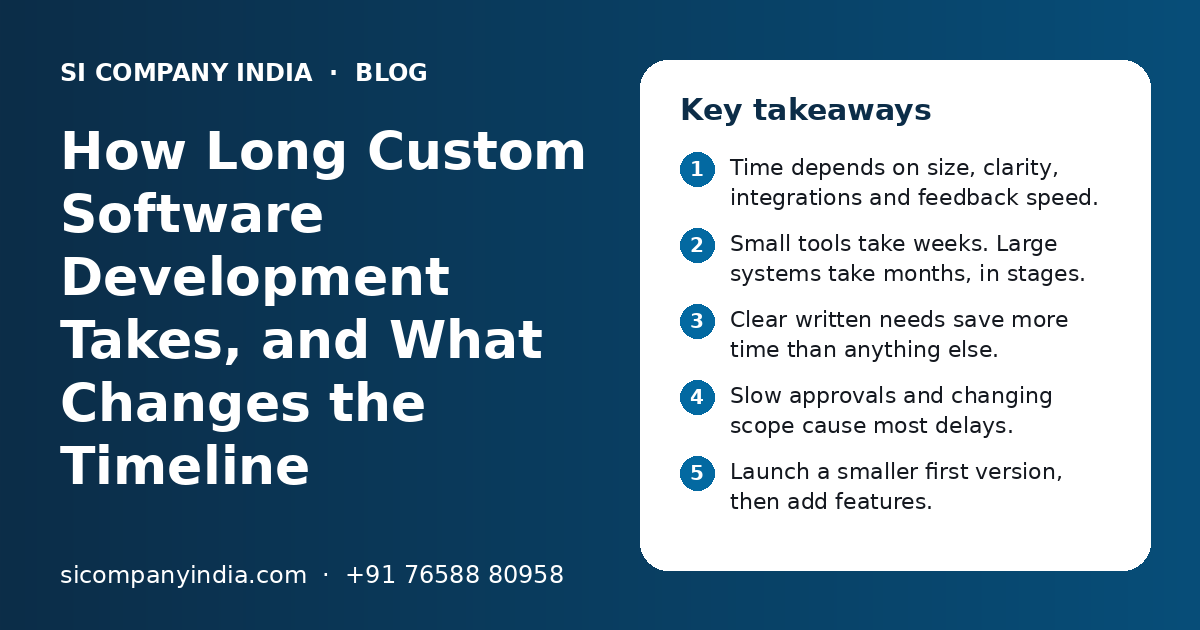
Key takeaways
- Time depends on size, clarity, integrations and feedback speed.
- Small tools take weeks. Large systems take months, in stages.
- Clear written needs save more time than anything else.
- Slow approvals and changing scope cause most delays.
- Launch a smaller first version, then add features.
- Ask for a stage-wise plan with dates, not one big date.
How long does custom software development take?
Custom software development can take anything from a few weeks to many months. The answer depends on what you are building, how clear your needs are and how quickly decisions are made on both sides.
Think of it like building a house. A single room is quick. A full house with plumbing, wiring and many floors takes longer. Software is the same. More screens, more user roles, more reports and more connections to other systems all add time.
So no honest company can give a timeline before it understands your work. If someone promises a fixed date in the first five minutes, ask how they arrived at it. A good team first studies your process, then breaks the work into stages and gives a date for each stage.
What are the stages of a software project, and how long is each?
Most software projects go through six stages: discovery, design, development, testing, launch and support. Each stage takes a different share of the total time.
- 1
Discovery and requirements
The team talks to you and your staff, studies your current process and writes down what the software must do. This is short, but it decides everything after it.
- 2
Design and planning
Screens are drawn as simple layouts. You see how each page will look and work before any code is written. The technical plan and the database are also planned here.
- 3
Development
Developers build the software, module by module. This is usually the longest stage. You should see working parts at regular intervals, not only at the end.
- 4
Testing
The team tests every screen and flow. Then your own staff test it with real examples from daily work. Bugs are fixed before launch.
- 5
Launch and data import
Old data from Excel, Tally or another system is moved in. Staff are trained. The software goes live, often with one team or branch first.
- 6
Support and improvements
After launch, small fixes and changes come up as people use the software. This stage continues for as long as you use the software.
| Stage | Share of time | What you do in this stage |
|---|---|---|
| Discovery | Small | Explain your process, share sample bills, reports and forms |
| Design | Small to medium | Review screen layouts and approve them |
| Development | Largest | Check demos and give feedback on time |
| Testing | Medium | Ask staff to test with real cases |
| Launch | Small | Clean old data, plan training, choose a go-live day |
| Support | Ongoing | Report issues and plan the next set of features |
How does the type of software change the timeline?
Simple tools with a few users and screens are fast. Systems that touch many departments, such as ERP, take the longest. The table below shows how common types of business software usually compare.
| Type of software | Relative time | Why |
|---|---|---|
| Simple internal tool (one task, few screens) | Short | One process, one or two user types |
| Customer or dealer portal | Short to medium | Logins, orders, invoices and status updates |
| CRM for sales teams | Medium | Leads, follow-ups, reports and often WhatsApp or calls |
| Mobile app with admin panel | Medium | Two parts to build: the app and the web panel |
| GST billing and stock software | Medium | Tax rules, invoice formats and stock rules must be exact |
| SaaS product for many customers | Medium to long | Sign-up, plans, billing and data kept separate per customer |
| ERP across departments | Long, in phases | Sales, purchase, stock, accounts and HR all connect |
If you plan an ERP, read our page on ERP software development. It explains why ERP is almost always built and released in phases. For a sales team, our CRM solutions page shows what a first version usually includes.
What makes software development take longer?
Software projects get delayed mostly because of unclear needs, changing scope and slow feedback, not because of slow coding. Technical surprises happen, but they are rarer than people think.
Common reasons for delay
- Requirements are only in someone's head, not written down.
- New features are added in the middle of development.
- The owner is busy and approvals wait for days.
- Different people in the business give different instructions.
- Sample data, invoice formats or logins for other systems arrive late.
- Integrations with Tally, payment gateways or government portals need extra checks.
- Old data is messy and needs cleaning before it can be imported.
- Staff are not free to test, so testing drags on.
Integrations deserve a special mention. Connecting your software to UPI payments, WhatsApp, Tally or a courier system often needs accounts, approvals or test keys from the other side. Start those early. Our API integration team can tell you what is needed for each one.
Need help with your project?
Talk to the SI Company India team. Free first call, simple advice, clear quote.
How can you speed up custom software development?
The fastest way to speed up a project is to be clear before it starts and quick during it. Write your needs, pick one decision-maker and launch a smaller first version.
- Write your needs in simple points before asking for quotes.
- Share real samples: bills, reports, forms and Excel sheets.
- Name one person who can approve screens and answer questions.
- Set a fixed weekly time to review progress.
- Mark each feature as must-have or nice-to-have.
- Start accounts for payment, SMS or WhatsApp services early.
- Clean your old data while development is going on.
- Keep new ideas in a list for the next phase.
Our software requirements checklist helps you write your needs in a clear way. Even one page of clear points can save many weeks of back and forth.
Should you add more developers to go faster?
Sometimes, but not always. More developers help when the work can be split into separate parts. They do not help much when the problem is unclear needs or slow approvals. If you have a long-term product, dedicated developers who stay with your project can keep a steady pace month after month.
MVP or full version: which gets you live sooner?
A smaller first version, often called an MVP, gets you live much sooner than a full version. You start using the software early and add features based on real use.
Why a first version helps
- You start getting value sooner
- Staff learn a smaller system first
- Real use shows which features matter
- Money is spent in smaller steps
What to watch
- Some staff may want everything at once
- You must plan the next phases clearly
- The base must be built to grow, not as a quick hack
- A few manual steps may stay for a while
For example, a distributor may first launch order booking and stock. Dealer logins, reports and Tally sync can come in the next phases. The team uses the system from early on, and each phase is smaller and easier to test.
How does the timeline affect the cost?
Time and cost are closely linked. Most of the cost of custom software is the time of designers, developers and testers, so anything that adds time usually adds cost.
This is why delays caused by changing scope are expensive. Each change means new design, new code and new testing. A change made on paper during discovery is cheap. The same change made after development is much costlier.
| Decision | Effect on time | Effect on cost |
|---|---|---|
| Clear written needs before start | Shorter | Lower and more predictable |
| Feature changes mid-way | Longer | Higher |
| Smaller first version | Shorter to launch | Spread over phases |
| Many integrations at once | Longer | Higher |
| Fast feedback from your side | Shorter | Lower |
| Rushed deadline with extra team | Shorter, sometimes | Higher |
We do not quote fixed prices on this blog, because every project is different. You get a clear quote after a free call. Our guide on software development cost in India explains the cost side in more detail.
What should a good project timeline from a software company include?
A good timeline breaks the project into stages, gives a date for each stage and lists what the company needs from you. It should also say how changes will be handled.
- A list of features in each phase.
- A start and end date for each stage.
- Demo dates where you see working software.
- What you must provide, and by when.
- Time set aside for your staff to test.
- A clear process for new requests and their effect on dates.
- Who to contact for updates, and how often you will hear from them.
Questions to ask before you agree to a timeline
- How did you work out this timeline?
- Which parts carry the most risk of delay?
- When will I see the first working screens?
- What happens to the date if I add a feature?
- How much time have you kept for testing and fixes?
- Who will manage the project day to day?
If you are not sure whether a timeline is realistic, a short session with our technology consulting team can help you review it.
How does SI Company India plan software timelines?
We start with a free call, study your process and then share a stage-wise plan with features, dates and what we need from you. You see working software at regular demos, not only at the end.
We build web applications, mobile apps, CRM, ERP and automation for businesses across India, fully online. Integrations with GST, UPI, WhatsApp and Tally are planned from day one, so they do not cause late surprises.
SI Company India is powered by Shivah Web Tech, with 11+ years of experience, a 25+ person in-house team and 500+ projects delivered. Our parent team is a Google Partner, Meta Business Partner and Shopify Partner, and is MSME registered and Startup India recognised.
Our team works Monday to Friday, 9:30 to 6:30 IST, with 24x7 emergency support for urgent issues. To plan your project, visit our software development page or contact us for a free call.
Frequently Asked Questions
How long does it take to build custom software for a small business?
It depends on what the software must do. A small tool with a few screens and one or two user types can be ready in a few weeks. Software with many modules, reports and integrations takes months. The best way to get a real answer is to share your needs in writing and ask for a stage-wise plan.
Why do software projects get delayed so often?
Most delays come from unclear requirements, features added in the middle and slow feedback or approvals. Late access to other systems, such as payment or WhatsApp accounts, and messy old data also slow things down. Writing needs clearly, naming one decision-maker and keeping new ideas for a later phase prevents most delays.
Can software be built faster if I pay more?
Sometimes. Adding more developers can help when the work splits cleanly into separate parts. It does not fix unclear needs or slow approvals, and too many people on a small project can even slow it down. A smaller first version with only must-have features is usually the more reliable way to launch sooner.
Is it better to launch a small first version or wait for the full software?
For most businesses, a small first version is better. You start using the software sooner, your staff learn it in smaller steps and real use shows which features matter. The base should still be built properly so it can grow. Later phases then add the remaining features in a planned way.
How long does testing take in a software project?
Testing time depends on the size of the software and how many real cases your staff can try. The developer team tests first, then your own people test with real bills, orders or records. Keep enough time for this. Rushing testing to meet a date often leads to problems after launch, which take longer to fix.
Does an ERP take longer than a CRM to build?
Usually yes. A CRM mainly covers leads, follow-ups and sales reports. An ERP connects many departments such as sales, purchase, stock, accounts and HR, and each part depends on the others. That is why ERP is normally built and released in phases, with the most important modules going live first.
What do I need to give the software company to avoid delays?
Give a written list of needs, sample bills, reports and forms, and the Excel sheets you use today. Name one person who can approve screens and answer questions quickly. Share access to systems that must connect, such as Tally or payment accounts, early. Also keep staff free for testing near the end.
Will I see progress during development or only at the end?
You should see progress during development. A good software company shows working screens at regular demos, so you can give feedback early. Seeing the software only at the end is risky, because problems found late are harder and slower to fix. Ask for demo dates in the project plan before work begins.