Quick answer
What is technical debt in business software, in simple words?
Technical debt in business software is the extra work you will need later because of shortcuts, quick fixes or old choices made earlier. Like a loan, it helps you move fast at first, but it charges interest. That interest shows up as slow changes, repeated bugs and rising support effort until the debt is paid down.
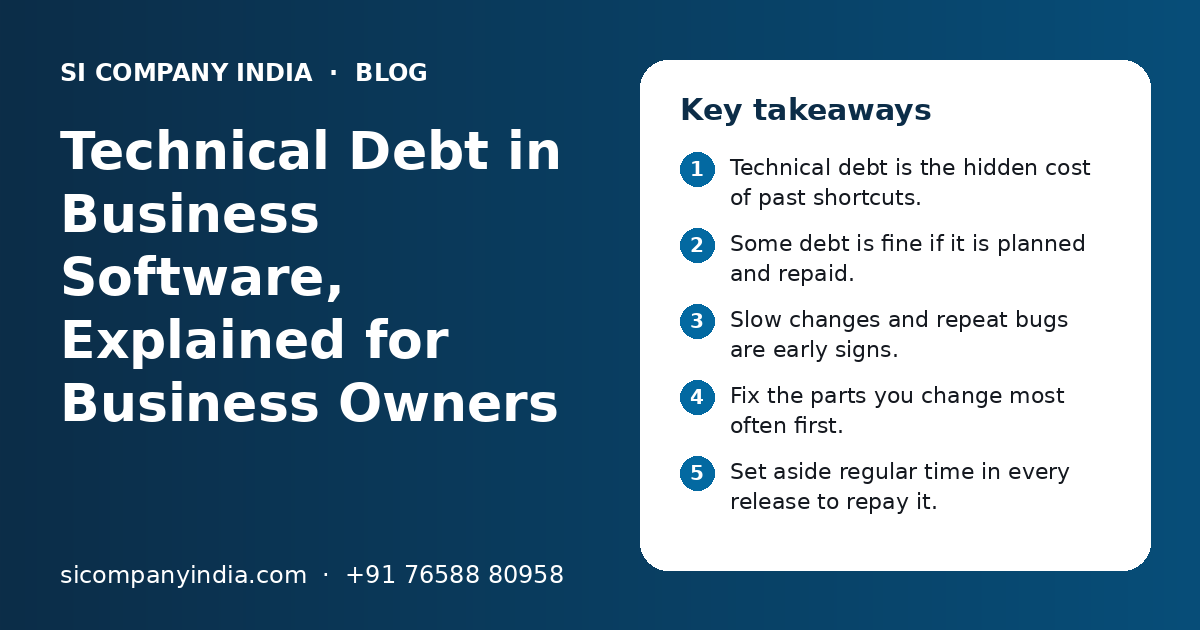
Key takeaways
- Technical debt is the hidden cost of past shortcuts.
- Some debt is fine if it is planned and repaid.
- Slow changes and repeat bugs are early signs.
- Fix the parts you change most often first.
- Set aside regular time in every release to repay it.
- Talk about it in business terms: time, risk, cost.
What is technical debt in business software?
Technical debt in business software is the future work created when software is built the quick way instead of the clean way. You save time today, but you pay it back later with slower changes and more fixes.
The idea works just like a business loan. A loan is not bad by itself. It can help you open a new branch faster. But if you never repay it, the interest keeps growing. In software, the interest is time. Each new feature takes longer because the team must work around old shortcuts.
Here is a simple example. Your billing software was built in a hurry before a GST deadline. The tax logic was copied into five different screens instead of one shared place. It worked. But now every rate change must be made five times, and if one is missed, invoices go wrong. That copied logic is technical debt.
Is technical debt always bad for a business?
No. Technical debt is a normal part of building software, and some of it is a smart choice. It becomes a problem only when nobody tracks it and nobody pays it back.
Sometimes speed matters more than perfection. You may need to launch before a festive season or show a working app to a big customer. Taking a planned shortcut then is a sound business call, as long as you note it and fix it soon after.
| Type of debt | How it happens | Is it a problem? |
|---|---|---|
| Planned debt | The team takes a known shortcut to meet a date and writes it down | Fine, if repaid on time |
| Accidental debt | The team did not know a better way at the time | Normal, fix it as you learn |
| Careless debt | Rushed work, no reviews, no tests, no notes | Risky, and it grows fast |
| Ageing debt | Tools, libraries or servers become old and unsupported | Risky for security and support |
The real danger is debt that is invisible. If your team says everything is fine but every task keeps getting slower, the debt is there. It is just not on anyone's list.
What are the signs of technical debt in your software?
The clearest signs are small changes taking a long time, the same bugs coming back and only one person who understands the system. You can spot these without reading any code.
- Simple changes, like a new field on a form, take days instead of hours
- Fixing one thing often breaks something else
- The same type of bug keeps coming back after each release
- Only one developer knows how the system works, and everyone fears that person leaving
- The team avoids touching certain screens or reports
- Releases need long manual testing and still go wrong
- The software runs on old versions that no longer get security updates
- Estimates keep growing for work that sounds simple
- Connecting a new tool, like a payment gateway or WhatsApp, feels very hard
If three or more of these are true, your software likely carries a lot of debt. A short review by someone outside the team can confirm it. Our technology consulting service includes this kind of health check.
What causes technical debt?
Most technical debt comes from rushed deadlines, unclear requirements, skipped testing and software that was never updated. It is usually a business process problem as much as a coding problem.
Business causes
- Deadlines set before the work is understood
- Requirements that change often, without time to clean up
- Choosing the lowest quote and cutting testing to fit it
- No budget for maintenance after launch
Technical causes
- Copy-paste code instead of shared parts
- No automated tests, so nobody dares to change things
- Little or no documentation
- Old frameworks, databases or servers that were never upgraded
- Many freelancers over the years, each with a different style
Changing vendors often also adds debt. Each new team learns the system from scratch and adds its own patches. A clean software project handover checklist reduces this a lot.
Need help with your project?
Talk to the SI Company India team. Free first call, simple advice, clear quote.
How does technical debt affect cost, speed and risk?
Technical debt makes every change slower and costlier, and it raises the risk of outages and security issues. The cost is hidden in longer timelines and bigger support bills.
| Area | Low technical debt | High technical debt |
|---|---|---|
| New features | Added in a predictable time | Take longer each time |
| Bugs | Rare and quick to fix | Frequent and hard to trace |
| New developers | Become useful quickly | Need a long time to learn the system |
| Security | Tools stay updated | Old parts may have known weaknesses |
| Integrations | New tools connect easily | Each link needs special workarounds |
| Growth | Handles more users and branches | Slows down or crashes under load |
Owners often see this as a vendor problem. The vendor seems slow or expensive. Sometimes that is true. But often the team is spending most of its time fighting old code. Our guide on software development cost in India explains how code quality affects what you pay over the years.
How do you reduce technical debt step by step?
Reduce technical debt in small, steady steps: list it, rank it by business impact, fix the busiest parts first and protect regular time for clean-up. A full rewrite is rarely the first answer.
- 1
Make a debt list
Ask your team to write down known problems in plain words, with the area of the software each one affects.
- 2
Rank by business impact
Put first the debt that slows down sales, billing, GST or customer-facing work.
- 3
Add tests around risky parts
Tests let the team change code without fear of breaking it.
- 4
Fix while you work
When a feature touches an area, the team cleans that area a little too.
- 5
Reserve regular time
Set aside a fixed share of each release cycle for debt work, agreed with the team.
- 6
Upgrade old tools
Plan upgrades of frameworks, databases and servers before support ends.
- 7
Review every quarter
Check the list, close what is done and add anything new.
If your team is stretched, extra hands help. Our dedicated developers can work on debt and upgrades while your main team keeps shipping features.
Refactor, rebuild or move to the cloud: which is right?
Refactor when the core design is sound but the code is messy. Rebuild only when the software cannot meet your needs even after clean-up. Move hosting when old servers are the main problem.
Refactor (clean up in place)
- Business keeps running as usual
- Lower risk, done in small parts
- Keeps the business rules already tested by use
- Results show up release by release
Rebuild (start again)
- Long project before you see value
- Old business rules can be missed
- Two systems may run side by side for a while
- Right only when the old base is truly beyond repair
Old hosting is a common source of debt too. If your software runs on one office server or an old setup, a planned cloud migration can reduce risk. When the problem is old links between tools, cleaner API integration is often the fix.
How should you talk to your software team about technical debt?
Talk about technical debt in business terms: time, risk and cost. Ask your team to explain each item as a business effect, and agree together on how much time goes to repaying it.
Many owners feel unsure here because they do not read code. You do not need to. You only need good questions and a team that answers them honestly.
- Which parts of the software slow you down the most, and why?
- What could break or stop working if we do nothing for a year?
- Are any tools or versions out of support or close to it?
- If we fix this area, what will become faster or safer?
- Can we fix it in small steps while features continue?
- How will we know the debt is going down?
Listen for plain, specific answers. Vague answers, or a quick push for a full rewrite, are a reason to get a second opinion. Also agree that new shortcuts must be written down when they are taken.
Put support and upkeep in writing too. Our post on what to include in a software SLA covers response times, updates and reports.
How do you avoid technical debt in new software?
You cannot avoid it fully, but you can keep it small with clear requirements, realistic deadlines, code reviews, tests and a maintenance budget from day one.
- Write clear requirements before work starts
- Choose a common, well-supported tech stack
- Ask for code reviews and automated tests in the scope
- Get documentation and full code access at handover
- Keep a short list of known shortcuts after each release
- Budget for maintenance and upgrades every year
Our post on how to choose a tech stack helps you avoid tools that age badly. SI Company India is powered by Shivah Web Tech, with 11+ years of experience, a 25+ member in-house team and 500+ projects. We work Monday to Friday, 9:30 to 6:30 IST, with 24x7 emergency support. See our software development work, or contact us for a free call. Cost depends on the size and age of your code, so you get a clear quote after that call.
Frequently Asked Questions
What is technical debt in simple words?
Technical debt is the extra work your software will need later because of shortcuts taken earlier. It is like a loan. You move faster at first, but you pay interest over time. In software, that interest is slower changes, more bugs and higher support effort until the shortcuts are fixed properly.
Is technical debt the same as bugs?
No. A bug is something that works wrongly today. Technical debt is a weakness in how the software is built that makes future work slower or riskier. Debt often causes bugs, because messy code is easier to break. But software can have debt and still work correctly for users right now.
How do I know if my software has too much technical debt?
Watch for simple changes that take days, bugs that keep coming back, a team that avoids certain parts of the system and only one person who understands it. Old versions without security updates are another sign. If several of these are true, ask for an outside code review to confirm.
Should I rewrite my software to remove technical debt?
Usually not as a first step. A full rewrite takes a long time, costs a lot and can miss old business rules. Most software can be improved by cleaning up the busiest parts step by step. A rewrite makes sense only when the base cannot support your business needs even after clean-up.
How much time should my team spend on technical debt?
There is no single right number. Many teams set aside a fixed share of each release cycle for clean-up and upgrades, and agree on it with the owner. The key is to make it regular and visible. Small, steady repayment works better than a big clean-up once in a few years.
Can a new vendor fix technical debt left by an old vendor?
Yes, but they first need full access to the code, the database, the servers and any notes. They will usually start with a review, then fix the riskiest areas while keeping the system running. Expect some time for learning, because the new team has to understand the old choices first.
Does technical debt affect security?
Yes. Old frameworks, plugins and server software may stop getting security updates. Messy code also makes it harder to spot weak points. Keeping tools updated and removing unused parts are two of the most useful ways to lower both technical debt and security risk at the same time.
Is technical debt a reason to change my software company?
Not by itself, because every software has some debt. It is a concern when the team hides it, cannot explain it in plain words or has no plan to reduce it. Ask for a written debt list and a repayment plan. If you still get no clear answers, a second opinion helps.