Quick answer
What should software for agri input dealers do?
Software for agri input dealers tracks seeds, fertilisers and pesticides by batch and expiry, makes GST bills, keeps a clear udhaar ledger for each farmer, plans stock for each crop season and handles orders between distributors and retailers. It also takes UPI payments, sends WhatsApp reminders, shows screens in Hindi or regional languages and syncs with Tally.
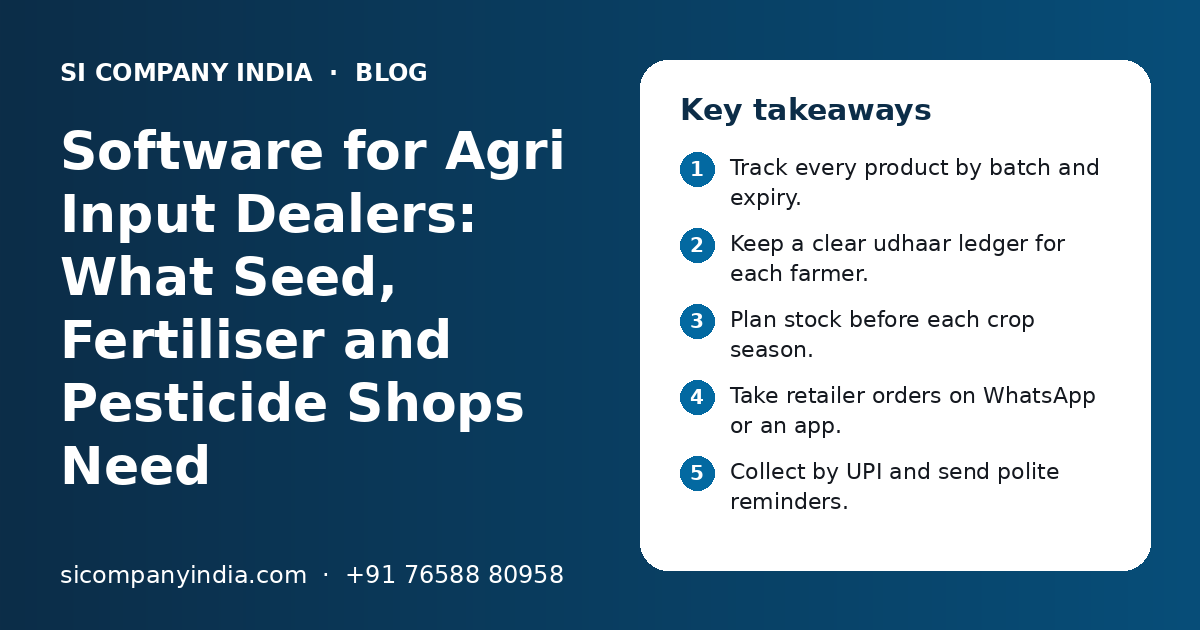
Key takeaways
- Track every product by batch and expiry.
- Keep a clear udhaar ledger for each farmer.
- Plan stock before each crop season.
- Take retailer orders on WhatsApp or an app.
- Collect by UPI and send polite reminders.
- Sync bills and receipts with Tally.
What is software for agri input dealers?
Software for agri input dealers is a billing, stock and credit system made for businesses that sell seeds, fertilisers, pesticides and other farm inputs. It brings bills, batches, farmer accounts and orders into one place.
Agri input businesses come in a few common shapes. Each needs a slightly different mix of features.
| Business type | Main customers | Most needed features |
|---|---|---|
| Village or town retail shop | Farmers | Fast billing, udhaar ledger, local language screens |
| Larger retail counter with branches | Farmers and small buyers | Multi-branch stock, transfers, owner reports |
| Distributor or wholesaler | Retail shops | Retailer orders, schemes, credit limits, collections |
| Company dealer network | Distributors and retailers | Order flow, secondary sales and stock visibility |
Most of these businesses already use a basic billing app or a register. The problem starts when stock, credit and season planning need to work together. That is where a system built for this trade helps.
How should batch and expiry tracking work?
Every product should be stored by batch, with its expiry or validity date, so the bill picks the right batch and the owner sees what will expire soon. This protects the farmer and cuts losses for the dealer.
Seeds, pesticides and many other inputs carry a batch number and a date on the pack. The software should ask for these details at purchase entry. At billing, it can suggest the batch that expires first, and print the batch on the bill. If a batch needs to be traced later, you can see who bought it.
- Batch number and expiry or validity date at purchase
- First-expiry-first-out suggestion at billing
- Batch printed on the bill
- Near-expiry report by product and by week
- Batch-wise sales history to trace a batch
- Returns to supplier marked against the batch
- Block on billing expired stock
What should GST billing look like in an agri input shop?
GST billing should be fast at the counter, show the right tax for each product and print or share the bill in a language the farmer can read. Different agri products can carry different GST treatment, so tax should be set per product.
At a busy counter in season, billing speed matters. Staff should be able to search by product name in Hindi or the local language, scan a barcode if the pack has one, and pick the batch in one tap. The bill can be printed, or sent on WhatsApp as a PDF.
- Product-wise HSN code and tax setup, confirmed with your CA
- Cash, UPI and credit sales in the same screen
- Bill of supply or tax invoice as your CA advises
- Bill in English, Hindi or a regional language
- Credit notes for returns
- Day-end cash and UPI summary
Our GST billing software development work covers invoice formats, credit notes, tax reports and links with stock. For subsidised products or special sale entries, ask your CA and the relevant department what records you must keep, and set the software to capture them.
How should a farmer credit or udhaar ledger work?
Each farmer should have one ledger that shows every credit sale, payment and balance, linked to the season. The owner should see total udhaar by village, season and age, so money does not get stuck.
Many farmers buy inputs on credit at sowing time and pay after harvest. This is normal in the trade, but it is also where many dealers lose track. A notebook cannot easily show who owes how much, since when, and for which season.
What a good udhaar ledger includes
- Farmer name, village, mobile number and guarantor if you note one
- Credit limit you set for each farmer
- Every credit bill with date, items and season tag
- Payments by cash, UPI or bank with receipt
- Season-wise and age-wise outstanding
- Statement in the farmer's language, shared on WhatsApp
Paper udhaar vs software udhaar
| Point | Paper notebook | Software ledger |
|---|---|---|
| Finding a balance | Turn many pages | Search name or mobile number |
| Season view | Hard to see | Filter by season and village |
| Proof for the farmer | Verbal or handwritten | Clear statement on WhatsApp |
| Reminders | Phone calls when someone remembers | Planned, polite reminders |
| Risk of loss | Notebook can be lost or damaged | Backed up data |
Interest or charges on credit, if any, should follow what you agreed with the farmer and what your CA advises. The software simply applies the rule you set.
Need help with your project?
Talk to the SI Company India team. Free first call, simple advice, clear quote.
How do you plan season-wise stock?
Season-wise stock planning means using last season's sales, current orders and crop trends in your area to decide what to buy and when. The software gives you the numbers. You add your local knowledge.
Demand for agri inputs rises and falls with the kharif and rabi seasons. If you buy too little, you lose sales at the peak. If you buy too much, money stays stuck and products may near expiry. The software should tag sales by season and show reports such as:
- Product-wise sales in the same season last year.
- Current stock against expected need for the coming season.
- Open orders from retailers or advance bookings from farmers.
- Slow-moving and near-expiry products to clear before new stock arrives.
- Supplier-wise purchase history and pending deliveries.
A distributor can also see which retailers bought which products last season and plan visits early. Owners who want all this on one screen can ask for a dashboard as part of an ERP development plan.
How can dealer and retailer orders, UPI and WhatsApp work together?
Retailers can place orders through a simple app or on WhatsApp, the distributor confirms stock and dispatch, and payments come by UPI. WhatsApp reminders then follow up on dues. Together this cuts phone calls and missed orders.
- 1
Retailer places an order
The retailer picks products from a list in a mobile app or sends an order on WhatsApp.
- 2
Stock and credit check
The system checks stock and the retailer's credit limit before confirming.
- 3
Bill and dispatch
The distributor makes the GST bill, picks the batches and records the vehicle.
- 4
Delivery confirmation
The driver or salesman marks delivery on a phone, with a photo if needed.
- 5
Payment by UPI
The bill carries a UPI QR code or payment link, and payment updates the ledger.
- 6
Reminder on WhatsApp
If dues stay open, the system sends a polite reminder with the statement.
UPI collection is set up through a payment gateway or bank partner. Our UPI payment integration work links payments back to the right bill and ledger. Automatic messages use the WhatsApp Business Platform with approved templates, which we set up through WhatsApp Business API integration. Farmers and retailers should agree to receive these messages.
For a company that sells through distributors, the same flow can show secondary sales and stock at each level. If you also deal in medicines or other batch products, our post on software for pharma distributors covers a similar setup.
Why do Hindi and regional language screens matter?
Counter staff, salesmen and many farmers are more comfortable in Hindi or their own regional language. Screens, bills and messages in that language mean fewer mistakes and better trust.
Language support should cover more than menu labels. Product names, bill formats, ledger statements and WhatsApp messages should all be available in the chosen language. Search should work with local spellings that staff actually type.
Benefits of local language screens
- New staff learn the system faster
- Farmers understand bills and statements
- Fewer wrong products picked at the counter
Points to plan
- Product names must be entered in each language
- Printers must support the script
- Messages must be tested in each language
Rural shops also face weak internet. An app that works offline and syncs later keeps billing running. Our post on offline-first business software explains how this works.
How does Tally integration help agri input dealers?
Tally integration sends sales, purchases, receipts and ledgers from your shop software to Tally, so your CA works on the same numbers without retyping. It also cuts errors at GST return time.
Most agri input dealers already keep books in Tally with help from their CA. The shop software handles the counter, stock and udhaar, while Tally handles accounts. Through Tally integration services, bills, payments and party ledgers move across on a schedule or at day end. Plan which data goes to Tally, how party names match and how often it syncs, then test with sample entries before going live.
Ready-made or custom software, and what affects cost?
Ready-made software suits a single shop with simple needs. Custom software suits distributors, multi-branch dealers and businesses that need retailer apps, special credit rules or deep links with Tally, UPI and WhatsApp. You get a clear quote after a free call.
| Cost factor | Why it matters |
|---|---|
| Number of shops and godowns | More locations need stock transfers and more testing. |
| Retailer or salesman app | Mobile apps with offline mode add work. |
| Languages | Each language needs labels, product names and print checks. |
| Credit and scheme rules | Special rules need more logic and reports. |
| Integrations | Tally, UPI and WhatsApp links each add effort. |
| Data migration | Moving old udhaar and stock needs care and checking. |
Mistakes to avoid
- Going live right at the start of a busy season.
- Loading old udhaar balances without checking them with farmers.
- Skipping batch entry at purchase to save time.
- Choosing software that cannot print in your local language.
- Training only the owner and not counter staff.
SI Company India is powered by Shivah Web Tech, with 11+ years of work, a 25+ member in-house team and 500+ projects. We work fully online with businesses across India from our Mohali, Punjab office, Monday to Friday, 9:30 to 6:30 IST, with 24x7 emergency support for urgent issues. Explore our custom software development work or contact us to plan your agri input software before the next season.
Frequently Asked Questions
What is the best billing software for a fertiliser and pesticide shop?
The right software is one that tracks batches and expiry, makes GST bills with the correct tax per product, keeps a farmer udhaar ledger, works in your local language and syncs with Tally. A small single shop may manage with a ready-made app. A distributor or multi-branch dealer often needs custom software that fits its credit rules and order flow.
Can agri input software manage farmer credit until harvest?
Yes. The software keeps a ledger for each farmer with every credit bill tagged to a season, plus all payments. You can see balances by farmer, village, season and age, set credit limits and send polite reminders on WhatsApp. Any interest or charges should follow what you agreed with the farmer and what your CA advises.
Does the software follow government rules for selling seeds and pesticides?
The software can store the details you need, such as batch, expiry, supplier and buyer records, and print them on bills or reports. But the rules themselves depend on the product and your state. Follow the rules that apply to your business and check them with your CA or the relevant authority, then set the software to match.
Can the software work in Hindi or other Indian languages?
Yes, if it is planned that way. Menus, product names, bills, statements and WhatsApp messages can be shown in Hindi or a regional language. Product names need to be entered in each language, and your printer must support the script. Test a few bills and messages in each language before you go live.
Will the software work in villages with weak internet?
A well-built system can keep billing running offline on a computer or phone and sync data when the internet returns. This matters for rural shops and salesmen on the road. Ask for offline billing clearly when you plan the software, and test it at your own shop with the network switched off.
Can retailers order from a distributor through an app?
Yes. Retailers can pick products from a list in a simple mobile app, or send orders on WhatsApp. The system checks stock and credit limit, the distributor confirms, and the bill and dispatch follow. This reduces phone calls, missed orders and wrong items, and gives the distributor a clear view of what each retailer buys.
How long does it take to set up software for an agri input business?
It depends on the number of products, shops, languages and integrations, and on how clean your current stock and udhaar records are. Checking old balances with farmers often takes as long as the software setup. The safest plan is to finish setup and staff training in the quiet period before the next season starts.