Quick answer
What are the main mobile app maintenance cost factors for a business app?
The main mobile app maintenance cost factors are Android and iOS updates, Play Store and App Store policy changes, server and hosting use, third-party APIs, bug fixes, security work, new features and the support hours you need. A simple app with few links costs less to maintain than a large app with payments and many users.
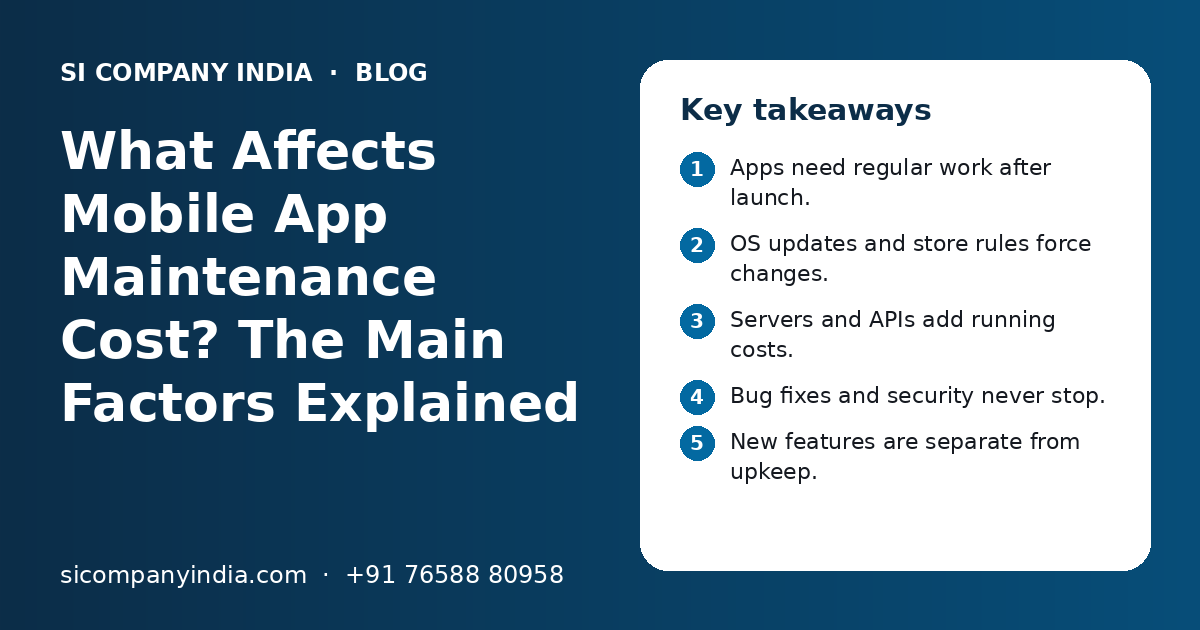
Key takeaways
- Apps need regular work after launch.
- OS updates and store rules force changes.
- Servers and APIs add running costs.
- Bug fixes and security never stop.
- New features are separate from upkeep.
- Support hours change the monthly cost.
Why does a mobile app need maintenance at all?
A mobile app needs maintenance because the world around it keeps changing. New phone software, new store rules, new devices and new security risks can break an app that worked fine on launch day.
Many owners plan a budget for building the app but not for running it. Then a payment stops working, or the store sends a warning email, and the fix becomes urgent. Knowing the mobile app maintenance cost factors early helps you avoid this.
If you are still planning your app, our mobile app development page explains how we build apps that are easier to maintain later. Our mobile app launch checklist covers what to set up before you go live.
What are the main mobile app maintenance cost factors?
The main mobile app maintenance cost factors are platform updates, store policy changes, servers, third-party APIs, bug fixes, security, new features and support hours. Each one adds work, and the mix is different for every app.
| Cost factor | What it means | Lower effort when | Higher effort when |
|---|---|---|---|
| OS updates | New Android and iOS versions | Simple screens, standard parts | Camera, GPS, Bluetooth, background tasks |
| Store policy changes | Play Store and App Store rules | Few permissions, little user data | Payments, location, health or child data |
| Server and hosting | Backend, database, file storage | Few users, small data | Many users, images, video, reports |
| Third-party APIs | Payments, SMS, maps, WhatsApp, logins | One or two links | Many links that change often |
| Bug fixes | Fixing crashes and wrong results | Well-tested code | Rushed code, old technical debt |
| Security | Patches, checks, data safety | No login, no personal data | Payments, personal and business data |
| New features | Changes your business asks for | Stable process | Frequent new ideas and campaigns |
| Support hours | Who answers and how fast | Office-hours help | Faster response and 24x7 cover |
The sections below explain each factor in simple terms.
How do Android and iOS updates affect maintenance cost?
Google and Apple release new phone software every year. Each release can change how permissions, notifications, background work or screens behave, so your app must be tested and often updated.
- Testing: the app must be checked on the new version before most users upgrade.
- Code changes: some old methods stop working and must be replaced.
- Libraries: the tools inside the app also release new versions that must be updated.
- New screen sizes: new phones, foldables and tablets may show layout problems.
- Old phones: you must decide which older versions you still support.
In India, many users keep budget Android phones for years. Supporting very old Android versions keeps more users happy, but it adds testing work. A clear minimum version keeps this factor under control.
Apps built with cross-platform tools, such as Flutter, share one code base for Android and iOS. That can reduce some update work, but the tool itself also needs regular upgrades.
Why do Play Store and App Store policy changes add work?
Both stores update their rules on a regular cycle. If your app does not follow a new rule by the deadline, the store can block updates or remove the app.
- Target version rules: stores ask apps to build for newer Android or iOS versions.
- Privacy and data forms: you must keep data safety and privacy details correct.
- Permission rules: apps must explain why they need location, contacts, SMS or camera.
- Account deletion: users may need a clear way to delete their account and data.
- Payment rules: digital goods and subscriptions have their own store rules.
- Developer account checks: stores may ask you to verify your business details.
Apps that handle payments, location or personal data usually see more policy work than a simple catalogue app. Plan for this in your yearly budget.
How do servers, hosting and APIs add to the cost?
Most business apps talk to a server for logins, orders, stock or reports. That server and the outside services the app uses all have running costs and need care.
Server and hosting
Hosting cost grows with users, stored data, images, videos and reports. Someone also needs to watch uptime, take backups, apply server updates and fix slow queries. Our cloud solutions page explains how hosting is planned and looked after.
Third-party APIs
Apps often use outside services for payments, SMS, OTP, maps, push alerts and WhatsApp messages. These services change versions, update rules and sometimes retire old methods. Each change needs code work and testing.
- UPI and payment gateways: updates to flows, security checks and refund handling. See our UPI payment integration page.
- WhatsApp messages: template rules and API changes. See our WhatsApp Business API integration page.
- Business software: links with CRM, ERP or Tally must keep working as those systems update.
- Usage fees: many APIs charge per message, per call or per transaction, so cost grows with use.
Our API integration team keeps these links tested and documented, so one change does not break the whole app.
Need help with your project?
Talk to the SI Company India team. Free first call, simple advice, clear quote.
How much do bug fixes and security work matter?
Bug fixes and security are steady, ongoing work. Every app has some bugs, and new ones appear as phones, data and users change.
- 1
Watch crash reports
Crash and error tools show which screens fail and on which phones. Review them every week.
- 2
Sort bugs by impact
A broken payment or login is urgent. A small layout issue on one rare phone can wait for the next release.
- 3
Fix and test
Fix the cause, then test on real low-cost and high-end phones before release.
- 4
Release in stages
Roll out to a small share of users first, then to everyone if no new problems show up.
- 5
Check security
Update libraries with known weak points, review logins and keep server software patched.
Code quality affects this cost a lot. An app built in a hurry, with little testing, usually needs more fixes later. Our post on technical debt in business software explains why shortcuts cost more over time.
Are new features part of maintenance cost?
New features are usually separate from basic maintenance. Upkeep keeps the app working as it is; new features change what the app does.
| Work type | Examples | Usually covered by |
|---|---|---|
| Upkeep | OS updates, store rules, small bug fixes | Maintenance plan |
| Small changes | New text, banner, minor field | Maintenance plan, within agreed hours |
| New features | Loyalty points, new language, new module | Separate quote or extra hours |
| Redesign | New look, new flows | Separate project |
Agree on this line before you sign. If the plan does not say what counts as a small change, both sides can end up unhappy. If you expect many new features, a dedicated developer model may suit you better than a basic plan.
How do support hours and response times change the cost?
Faster response and longer cover cost more because a team must be ready to act. Office-hours support is enough for many internal apps. Customer-facing apps with payments may need faster help.
Office-hours support
- Lower monthly cost
- Fine for staff and field apps
- Planned releases on working days
Extended or 24x7 support
- Higher monthly cost
- Needed when payments or orders run all day
- Clear rules for what counts as urgent
Write response times, fix times and contact methods into a service level agreement. Our post on what to include in a software SLA gives a simple list.
How can you keep mobile app maintenance costs under control?
Keep costs under control by building clean code from the start, limiting extra tools, and planning updates on a fixed rhythm instead of in a rush.
- Keep the source code, store accounts and server logins in your company's name.
- Ask for basic documentation and a list of every third-party service used.
- Remove features and SDKs nobody uses.
- Set a minimum Android and iOS version and review it once a year.
- Plan a regular update cycle, such as monthly or quarterly.
- Track crash reports and store emails every week.
- Separate upkeep from new features in your budget.
To compare app costs with other software work, see our guide on software development cost in India.
How does SI Company India quote for app maintenance?
We look at your app, its code, its server and its links, then suggest a plan that fits how you use it. We do not give fixed prices without seeing the app. You get a clear quote after a free call.
SI Company India is powered by Shivah Web Tech, with 11+ years of work, a 25+ in-house team and 500+ projects. We work fully online with businesses across India. Office hours are Monday to Friday, 9:30 to 6:30 IST, with 24x7 emergency support for urgent issues.
Contact us to book a free call. Share your app's store links, the services it uses and your main worries, and we will explain what your plan should cover.
Frequently Asked Questions
How much does mobile app maintenance cost in India?
There is no single price. Cost depends on the app's size, number of users, server use, third-party APIs, payment and data handling, how often you want updates and the support hours you need. A simple internal app costs less to maintain than a large customer app with payments. You get a clear quote after a free call.
Why does my app need updates if it works fine?
Android and iOS change every year, the app stores update their rules, and outside services like payment gateways change their systems. An app that works today can break or be blocked later if nobody updates it. Regular updates keep it working, safe and allowed on the stores.
What is included in a mobile app maintenance plan?
A typical plan covers OS update testing, store policy changes, bug fixes, library and security updates, server checks, backups and a set number of hours for small changes. Large new features and redesigns are usually quoted separately. Always ask for a written list of what is and is not included.
Can the store remove my app if I do not maintain it?
Yes. The Play Store and App Store can block updates or remove apps that do not meet new rules by the deadline, such as target version or privacy rules. They usually send warning emails first. Make sure someone reads those emails and acts on them in time.
Is server hosting part of app maintenance cost?
Hosting is a running cost that sits alongside maintenance. The server bill depends on users, data, images and traffic. Maintenance covers the work of looking after the server, such as updates, backups, monitoring and fixing slow parts. Ask your team to show both clearly in the quote.
Should I hire my own developer or take a maintenance plan?
A maintenance plan suits most small and mid-size businesses, because you get a team that covers app, server and APIs together. A dedicated developer suits you if you add new features every month. Some businesses start with a plan and move to a dedicated model as the app grows.
Can you maintain an app that another company built?
Usually yes, if you have the source code and access to the store accounts and servers. The first step is a code review to understand its condition. Older or rushed code may need some clean-up before regular maintenance becomes smooth. This review also helps give a fair quote.