Quick answer
What should software for pharma distributors in India include?
Software for pharma distributors in India should track every item by batch and expiry, make GST bills with batch, expiry and MRP details, handle schemes and discounts, manage near-expiry stock and returns, take retailer orders on WhatsApp or an app, track routes and collections, and sync with Tally so accounts stay correct without double entry.
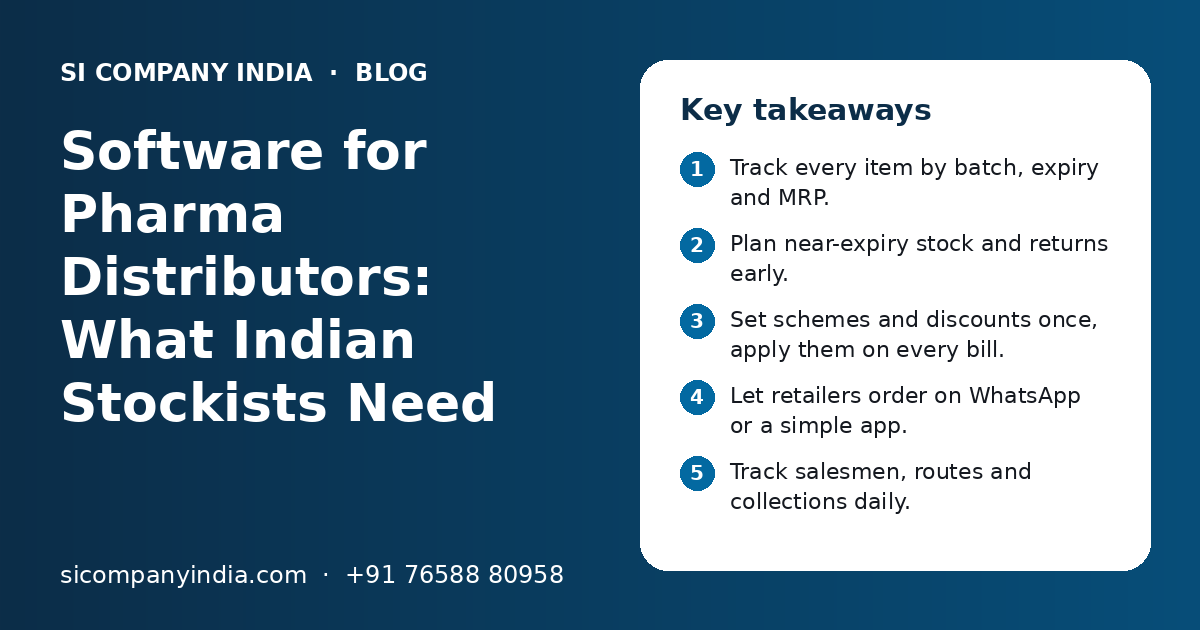
Key takeaways
- Track every item by batch, expiry and MRP.
- Plan near-expiry stock and returns early.
- Set schemes and discounts once, apply them on every bill.
- Let retailers order on WhatsApp or a simple app.
- Track salesmen, routes and collections daily.
- Sync bills and receipts with Tally to avoid double entry.
Why do pharma distributors need special software?
Pharma distributors need special software because medicines are tracked by batch and expiry, not just by item name. General billing tools often cannot handle batches, schemes, near-expiry returns and retailer credit the way a medicine wholesale business works.
A typical pharma wholesaler or stockist buys from many companies, sells to many chemists, hospitals and sub-stockists, and offers credit to most of them. Each product can have several batches in stock at the same time, each with a different expiry date and sometimes a different MRP.
If this is managed in a simple billing tool or in Excel, common problems appear:
- Old batches stay on the shelf while new batches are sold, so stock expires.
- Wrong batch or expiry is printed on the bill.
- Scheme free goods are missed or given twice.
- Payments from retailers are not followed up on time.
- Accounts in Tally do not match the billing data.
Good software for pharma distributors in India solves these as one connected system. Our ERP software development page explains how such systems are planned.
How should batch and expiry tracking work?
Every purchase should be entered with batch number, expiry date, MRP and purchase rate, and every sale should pick a specific batch. The software should suggest the batch that expires first, so older stock moves out first.
What batch tracking should include
- Batch number, manufacturing date (if needed), expiry date and MRP saved at purchase.
- Batch-wise stock for each item and each godown or rack.
- Automatic FEFO batch suggestion while billing.
- Block on billing expired batches.
- Batch search, so you can find who received a batch if a company asks for a recall.
- Barcode or QR scanning at purchase and dispatch, where your products support it.
How do you manage near-expiry stock and returns?
The software should show near-expiry stock in advance, such as three or six months before expiry, so you can push it, return it or claim it. It should also record returns from retailers and returns to companies with batch details.
Expiry and breakage returns are a daily part of pharma distribution. Retailers send back near-expiry or damaged goods. You then return them to the company or adjust them as per the company's policy. Without clear records, this becomes a source of loss.
- 1
Set expiry alerts
Choose how many months before expiry an item should show as near-expiry. Different companies may need different windows.
- 2
Review near-expiry reports
Check a weekly report by company, item and batch. Ask salesmen to push those batches first.
- 3
Record retailer returns
Enter each return with batch, quantity, reason (expiry, breakage, wrong supply) and the credit note issued.
- 4
Group returns by company
Collect returns company-wise, with batch lists, ready to send back or claim.
- 5
Track claims
Mark what was sent, what the company accepted and what credit was received.
This simple loop helps you see where money is stuck in returns. A clear dashboard, as covered in our data analytics page, makes the numbers easy to read.
What should GST billing look like for a pharma wholesaler?
Bills should be proper GST tax invoices with HSN codes and the correct tax split, and they should also carry the pharma details that buyers expect, such as batch, expiry and MRP for each line.
Pharma invoices usually show more than a normal GST bill. Common line details are item name, pack size, batch number, expiry date, MRP, rate, discount, free quantity, GST rate and amount. Drug licence numbers of the seller, and often of the buyer, are commonly printed on wholesale invoices. Please confirm the exact invoice details you need with your CA and your drug licence adviser, because rules can change.
Fast counter billing
Search items by name or short code, pick batch, and print in seconds.
Credit notes
Linked to returns, with batch and reason.
E-way bills and e-invoices
Data prepared for the government portals where your business needs them.
Party-wise rates
Different rates or discounts for chemists, hospitals and sub-stockists.
We build these features as part of GST billing software development. Your CA keeps the final say on tax rules and filing.
Need help with your project?
Talk to the SI Company India team. Free first call, simple advice, clear quote.
How should schemes and discounts be handled?
Schemes and discounts should be set up once in the software and applied on every bill automatically. Staff should not need to remember which item has which scheme this month.
Pharma companies run many kinds of offers. A distributor also gives its own discounts to good customers. Mixing these by hand leads to mistakes.
| Type of offer | Example | What the software should do |
|---|---|---|
| Free quantity scheme | Buy 10 strips, get 1 free | Add free quantity on the bill and reduce stock for both |
| Trade discount | Fixed percent off the rate | Apply discount by item, company or party |
| Cash discount | Extra discount for quick payment | Apply on payment within the agreed days |
| Party-wise special rate | Lower rate for a hospital | Pick the special rate when that party is billed |
| Time-bound scheme | Offer valid for one month | Start and stop on set dates without manual change |
| Company claim | Company reimburses scheme cost | Report scheme given, ready to claim from the company |
The last row matters a lot. If the software keeps a clear record of schemes given, you can claim them from the company with proof, instead of building reports by hand.
How can retailers order on WhatsApp or an app?
Retailers can send orders through a WhatsApp chat linked to your stock, or through a simple ordering app with your product list, rates and schemes. Orders then flow straight into billing, without retyping.
Many chemists already send orders as WhatsApp messages or photos of handwritten lists. Someone in the office then types them into the billing system. This is slow and errors are common.
Options for taking retailer orders
- WhatsApp ordering: the retailer picks items from a list in WhatsApp, and the order is saved in your system. See WhatsApp Business API integration.
- Retailer app: a simple mobile app where retailers see items, stock status, rates and schemes, and place orders.
- Salesman app: salesmen book orders on their phone at the shop, even when the network is weak, and sync later.
- Order status and bills sent back on WhatsApp, with a payment link through UPI payment integration.
Start with the channel your retailers already use. For most distributors, that is WhatsApp.
How do you track routes, deliveries and collections?
Plan routes by area and day, give each salesman and delivery person a mobile app, and record every order, delivery and payment against the right retailer. Outstanding reports should be ready every morning.
Credit is a big part of pharma distribution. Collections decide your cash flow. The software should make it easy to see who owes what, and to follow up politely but on time.
- Area and day-wise beat plan for salesmen.
- Delivery list per vehicle, with proof of delivery.
- Party-wise outstanding with bill age (for example 0–30, 31–60, 60+ days).
- Credit limit and credit days per retailer, with a warning when crossed.
- Collection entry in the app: cash, cheque or UPI, with receipt on WhatsApp.
- Daily collection report by salesman.
Some distributors also want location check-ins for field visits. Our logistics software page explains route and delivery tracking in more detail.
Can pharma distributor software work with Tally?
Yes. Many distributors keep their accounts in Tally, and the billing or distribution software can send sales, purchases, credit notes and receipts to Tally so the accountant does not enter them again.
This way, the warehouse and sales team work in the distribution software, and the accountant keeps using Tally for ledgers, GST returns and reports. The two stay in sync.
Points to agree before you start: which vouchers will flow, how party and item names will match, how often the sync runs, and who fixes errors. Our Tally integration services page covers these points.
Ready-made or custom software for a pharma distributor?
Ready-made pharma software suits many small distributors with standard needs. Custom software suits distributors with special schemes, many branches, their own retailer app or links to other systems.
Ready-made is a good fit when
- You have one godown and a small team
- Your billing and schemes are standard
- You want to start quickly
- You do not need a retailer app
Custom is a good fit when
- You keep side sheets for schemes, claims or returns
- You run several branches or godowns
- You want your own retailer and salesman apps
- You need links to Tally, WhatsApp, UPI and company portals
A mix also works. Some distributors keep a ready-made billing tool and add a custom retailer app or dashboard on top. Our guide on software development cost in India explains what affects the cost of custom work.
SI Company India is powered by Shivah Web Tech, with 11+ years of experience, a 25+ in-house team and 500+ projects. We work fully online across India. You get a clear quote after a free call.
Frequently Asked Questions
What is the best software for a pharma distributor in India?
The right software is the one that fits your size and way of working. It should handle batch and expiry tracking, GST billing with pharma details, schemes, returns, retailer credit and Tally sync. Small distributors often start with ready-made software. Larger or growing distributors may need custom software or a custom app added to their current tool.
Does pharma billing software need batch and expiry on the invoice?
Most pharma wholesale invoices show batch number, expiry date and MRP for each line, because retailers and hospitals need these details for their own stock and records. Your software should print them automatically. Confirm the full list of invoice details required for your business with your CA and drug licence adviser.
How can software reduce expired stock for a distributor?
Software reduces expired stock by suggesting the nearest-expiry batch while billing, showing near-expiry reports months in advance, and listing slow batches so salesmen can push them. It also records returns batch-wise, so you can send them back to companies and claim credit on time instead of finding them too late.
Can retailers place orders on WhatsApp with distributor software?
Yes. With the WhatsApp Business API, retailers can choose items from a list or send an order in a chat, and the order is saved straight into your system. They can also get bill copies, outstanding details and UPI payment links on WhatsApp. This saves office staff from retyping orders.
Can pharma distribution software sync with Tally?
Yes. Sales bills, purchase bills, credit notes and receipts can be sent from the distribution software to Tally. The accountant keeps working in Tally for ledgers and GST returns. Before setup, agree on which entries will sync, how names will match and how often the sync will run.
How long does it take to build custom software for a pharma distributor?
It depends on the modules. A focused system for billing, batch stock and Tally sync takes less time than a full system with retailer apps, salesman apps, route planning and dashboards. Most teams start with the core billing and stock module, go live, and then add apps in later phases. You get a clear plan and timeline after a free call.
Is a salesman app useful for a small pharma stockist?
It can be. Even with a few salesmen, an app helps book orders at the shop, see stock and schemes, and record collections with receipts. The office gets orders and payments the same day. Start with simple features and add route plans or location check-ins only if you need them.
What data should I move when switching pharma software?
Move item masters with pack sizes, HSN codes and GST rates, party masters with GSTIN and licence details, current batch-wise stock with expiry and MRP, open bills and outstanding balances, and active schemes. Old bill history can be moved or kept in the old system for reference. Check all opening figures before going live.