Quick answer
How do I choose a tech stack for business software if I am not technical?
To choose a tech stack for business software, focus on business factors, not trends. Pick widely used tools that many developers in India know, that fit your scale and budget, connect with your other systems, are secure and will be supported for years. Ask your software company to explain why each part suits your project.
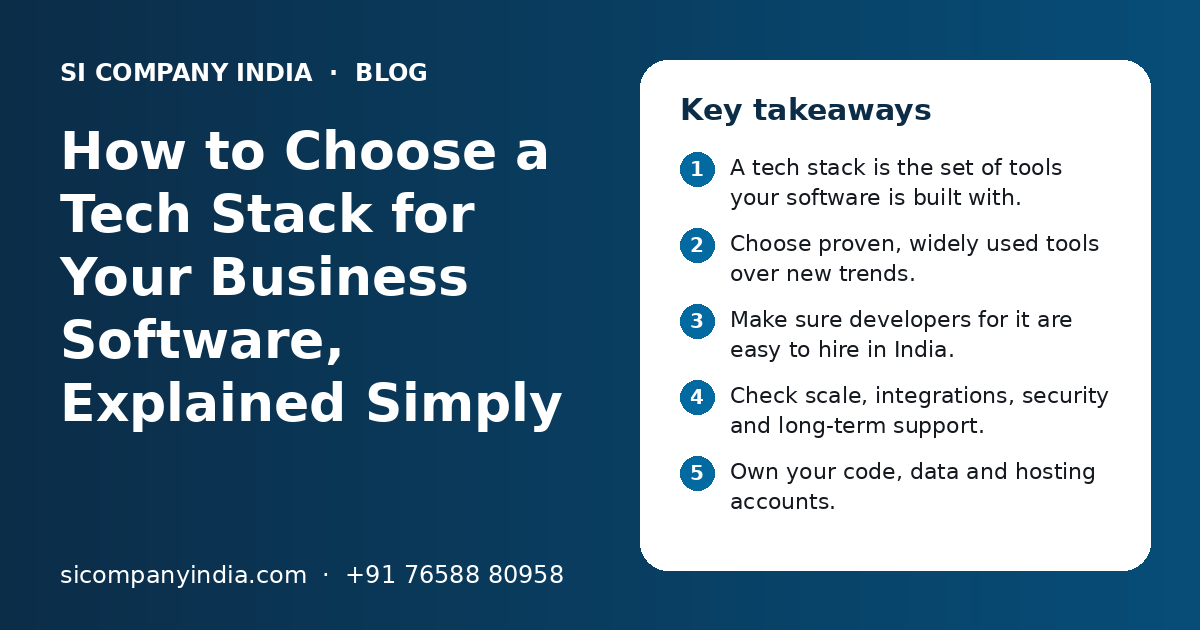
Key takeaways
- A tech stack is the set of tools your software is built with.
- Choose proven, widely used tools over new trends.
- Make sure developers for it are easy to hire in India.
- Check scale, integrations, security and long-term support.
- Own your code, data and hosting accounts.
- Ask your developer to explain every choice in plain words.
What is a tech stack, in simple words?
A tech stack is the set of programming languages, frameworks, databases and hosting services used to build and run your software. Think of it as the materials and tools used to build a house.
When you build a house, you choose bricks, cement, steel and wiring. A good builder picks materials that are strong, easy to find and easy to repair. Software is the same. The choice of stack decides how fast the software is built, how easy it is to change later and how easily you can find people to support it.
Knowing how to choose a tech stack for business software does not mean learning to code. It means asking the right business questions, so the technical team picks tools that suit your goals.
What are the main parts of a tech stack?
Most business software has four main parts: the front end, the back end, the database and the hosting. Each part has its own set of common tools.
| Part | What it means in plain words | Common examples |
|---|---|---|
| Front end | The screens, buttons and forms your staff and customers see | React, Angular, Vue.js, plain HTML with CSS |
| Back end | The logic that runs behind the screens, like rules, calculations and permissions | Laravel (PHP), Node.js (JavaScript), Django (Python), .NET (C#), Spring (Java) |
| Database | Where all records are stored, such as customers, orders and invoices | MySQL, PostgreSQL, Microsoft SQL Server, MongoDB |
| Hosting | The computers on the internet where the software runs | AWS, Microsoft Azure, Google Cloud, Indian VPS or cloud providers |
| Mobile (if needed) | Apps for Android and iPhone | Flutter, React Native, native Kotlin or Swift |
A simple example
Say a salesperson opens your order app on a phone. The screen they see is the front end. When they tap "Save order", the back end checks stock, applies GST and prices. The database saves the order. All of this runs on a cloud server, which is the hosting.
Many projects also use extra tools, such as payment gateways, WhatsApp messaging or links to Tally. These connect to the back end through APIs. Our API integration page explains how this works.
Which factors matter most when choosing a tech stack?
The factors that matter most are the skills of your team, how easy it is to hire developers in India, the scale you expect, your budget, the tools you must connect, security needs and long-term support.
1. Team skills
If you already have an in-house developer or IT team, a stack they know well is often the safest choice. A new tool that nobody on the team knows adds risk and slows work.
2. Hiring availability in India
Your software will need changes for years. Choose tools that many Indian developers already work with. If your partner changes or a developer leaves, you can find a replacement without a long search. Rare tools make every future hire harder.
3. Scale
Think about how many users, branches and records you expect in three to five years, not only today. Most widely used stacks can handle a growing business when the software is designed well. Very large or real-time systems may need special planning.
4. Budget and speed
Some frameworks come with many ready parts, such as logins, forms and admin panels. This can save build time. Hosting and licence costs also differ between stacks, so ask about running costs, not only build costs.
5. Integrations
List every tool the software must talk to: Tally, a GST e-invoice system, UPI or payment gateways, WhatsApp Business API, IndiaMART, a courier partner or your website. Check that the stack can connect to them easily.
6. Security
Business software holds customer data, prices and money records. Choose tools that receive regular security updates and support role-based access, encryption and safe logins.
7. Long-term support
Prefer tools with an active community and regular updates. Avoid tools that look abandoned. Software that is hard to update becomes old and risky quickly.
How do common tech stack choices compare?
Each common stack has its own strengths. There is no single right answer for every business. The table below gives a simple, general comparison to help you talk to your developer.
| Back end option | Language | Often used for | Things to keep in mind |
|---|---|---|---|
| Laravel | PHP | Business portals, CRMs, ERPs, admin panels | Many developers in India know PHP; easy to host |
| Node.js | JavaScript | Real-time apps, chat, APIs, dashboards | Same language on front and back end |
| Django | Python | Data-heavy apps, reports, AI features | Python is also used for data and AI work |
| .NET | C# | Large company systems, Windows-based setups | Good fit when you already use Microsoft tools |
| Spring | Java | Large, complex enterprise systems | Often needs a bigger, more senior team |
| Database option | Type | Good for |
|---|---|---|
| MySQL | Relational (tables) | Most business apps with clear records like orders and invoices |
| PostgreSQL | Relational (tables) | Business apps that need complex queries and reports |
| Microsoft SQL Server | Relational (tables) | Companies already using Microsoft systems |
| MongoDB | Document (flexible records) | Data that changes shape often, like logs or content |
For most business software with accounts, stock, orders and invoices, a relational database is a natural fit, because the data has clear links. Ask your developer to explain why they chose one type over the other.
Need help with your project?
Talk to the SI Company India team. Free first call, simple advice, clear quote.
Where should your business software be hosted?
Most new business software is hosted on cloud servers, because they are easy to grow, back up and reach from anywhere. The key is that the hosting account should be in your company's name.
Cloud hosting
- Staff can use it from any branch or phone
- Easy to add more power as you grow
- Backups and security tools built in
- No hardware to buy or repair
Office server
- Works when the internet is down inside the office
- Hardware must be bought, cooled and maintained
- Backups depend on your own team
- Remote access needs extra setup
Some businesses prefer data centres in India for faster access and comfort. Major cloud providers offer Indian regions. Our cloud solutions team can help you pick a plan. If you are still deciding between online and installed software, read our post on cloud vs desktop software.
How do you choose a tech stack for business software, step by step?
Start from your business needs, then let the technical team match tools to them. Follow these steps in order.
- 1
Write down what the software must do
List users, main tasks, reports and the tools it must connect to.
- 2
Decide web, mobile or both
Field staff may need a mobile app; office teams may only need a web app.
- 3
Estimate growth
Note expected users, branches and data in the next few years.
- 4
Check your team
See if you have developers today, or will depend on an outside partner.
- 5
Ask for a stack proposal
Get the software company to suggest a stack and explain each part in plain words.
- 6
Check hiring and support
Make sure other developers in India could support it if needed.
- 7
Confirm ownership
Agree that code, database and hosting accounts belong to you.
If you want an outside view before you build, our technology consulting service helps you review options. Our post on low-code vs custom software development also helps if you are unsure whether you need a full custom build.
What questions should you ask a software company about its tech stack?
Ask why they chose each tool, who else can support it, who owns the code and accounts, and how updates and security will be handled. Clear answers in plain words are a good sign.
- Why is this stack a good fit for my project, not just for your team?
- Is it easy to find other developers in India for this stack?
- Will the code be stored in a Git account that my company owns?
- Will the hosting and database be in my company's name?
- How will the software connect with Tally, UPI, WhatsApp or our other tools?
- How will you handle security updates and backups?
- What will hosting cost each month as we grow?
- Will you give documentation and a proper handover at the end?
- How long will this framework version be supported?
A good partner will answer these without hiding behind jargon. Our software project handover checklist lists what you should receive at the end of a project. To see how we work, visit our software development page.
What mistakes should you avoid when choosing a tech stack?
The biggest mistakes are choosing a tool because it is trendy, picking a stack that only one developer knows and not owning your code and accounts.
- Choosing the newest tool because it is in the news
- Using a rare stack that is hard to hire for in India
- Letting the developer keep the hosting and code in their own name
- Building a mobile app when a mobile-friendly web app would do
- Planning only for today's users and not for growth
- Ignoring monthly hosting and licence costs
- Mixing too many tools for a small project
- Skipping documentation, so nobody else can understand the code
If you are not sure between an app and a website, our post on web app vs mobile app for business can help. For browser-based systems, see our web application development page.
Does the tech stack affect the cost of business software?
Yes, the stack affects cost, but your features, integrations and timeline usually matter more. We do not share fixed prices here. You get a clear quote after a free call.
- How many ready parts the framework gives, which affects build time
- Developer availability and experience for that stack
- Licence costs for some databases or tools
- Monthly hosting needs as users and data grow
- Cost of future changes and support
Read more on software development cost in India to see what else changes the budget. SI Company India is powered by Shivah Web Tech, with 11+ years of experience, a 25+ member in-house team and 500+ projects. We work Monday to Friday, 9:30 to 6:30 IST, with 24x7 support for urgent issues. Contact us for a free call.
Frequently Asked Questions
What is a tech stack in simple words?
A tech stack is the set of tools used to build and run software. It includes the front end, which users see, the back end, which holds the logic, the database, which stores records, and the hosting, where the software runs. Choosing a stack is like choosing building materials for a house.
Which tech stack is best for business software in India?
There is no single best stack for every business. A good choice is a widely used, well-supported stack that many Indian developers know, that fits your scale and budget and connects with your other tools. Laravel, Node.js, Django and .NET with MySQL or PostgreSQL are all common, proven options for business software.
Do I need to understand coding to choose a tech stack?
No. Your job is to explain what the software must do, who will use it, how it should grow and what it must connect to. The software company should then suggest a stack and explain each part in plain words. If they cannot explain it simply, ask more questions or get a second opinion.
Can I change the tech stack later?
You can, but it is usually costly and slow, because much of the software may need to be rebuilt. This is why it is worth choosing carefully at the start. Picking common, well-supported tools and keeping good documentation makes future changes and upgrades much easier, even if you change your development partner.
Should business software use the same stack as our website?
Not always. A marketing website and business software have different jobs. Using the same stack can make support simpler if one team handles both. But the software should use whatever stack fits its needs best. The two can still be linked through APIs, for example to send website leads into your CRM.
Is open source technology safe for business software?
Yes, when it is well maintained and kept updated. Many widely used frameworks and databases are open source and run serious business systems. The key is to use stable versions, apply security updates on time, set up safe logins and access rules, and keep regular backups of your data.
Who should own the code and hosting accounts?
Your company should own them. Ask for the source code in a Git account in your name, and the hosting, domain and database accounts also in your name. Your developer can be given access. This way you stay in control and can move to another partner later if you ever need to.