Quick answer
Which is better for an Indian SME, low-code or custom software development?
In low-code vs custom software development, low-code is better for simple internal tools you need quickly, such as forms, approvals and basic trackers. Custom software is better when your process is unique, you need full control of code and data, many users, deep integrations or a product you will grow for years. Many SMEs use both.
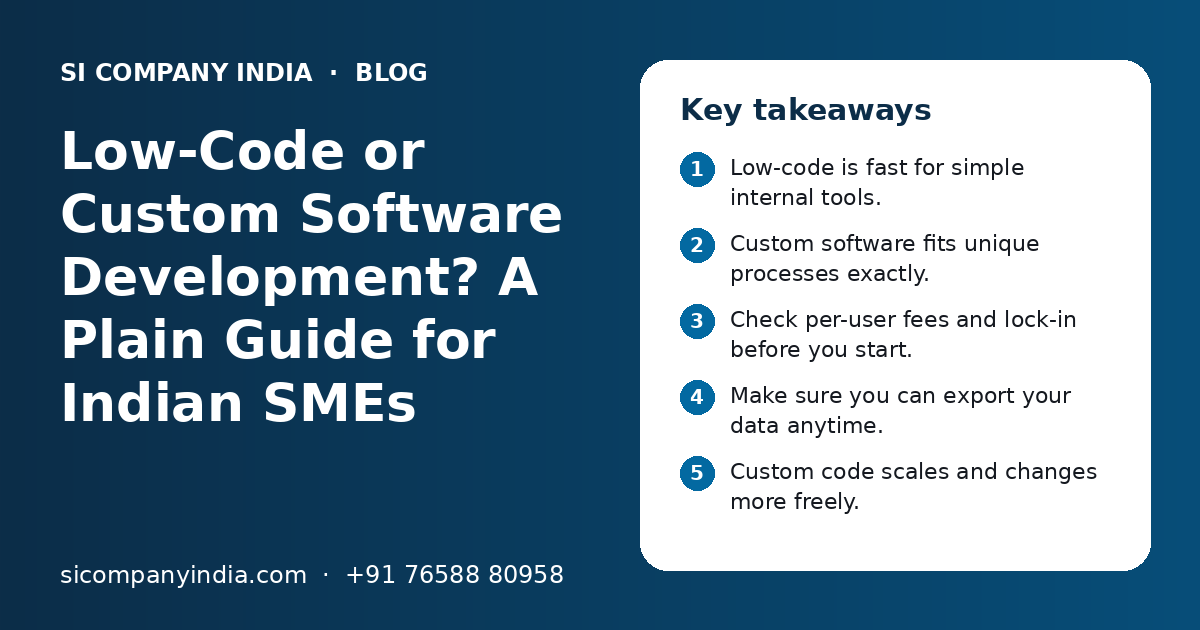
Key takeaways
- Low-code is fast for simple internal tools.
- Custom software fits unique processes exactly.
- Check per-user fees and lock-in before you start.
- Make sure you can export your data anytime.
- Custom code scales and changes more freely.
- A mix of both often works best.
What is the difference between low-code and custom software development?
The main difference in low-code vs custom software development is how the software is made. Low-code apps are built on a ready platform with drag-and-drop screens, while custom software is written in code by developers to fit your exact needs.
There is also no-code, which uses no code at all. No-code tools suit very simple forms and lists. Low-code sits in the middle. Custom software sits at the other end, with the most freedom and the most planning.
Think of it like a house. Low-code is a ready flat where you choose paint and furniture. Custom software is a house built on your own land to your own plan. The flat is faster to move into. The house fits better and you can extend it.
How do low-code and custom software compare side by side?
Low-code wins on starting speed and ease for simple apps. Custom software wins on flexibility, ownership and long-term growth. The table shows the main points.
| Point | Low-code | Custom software |
|---|---|---|
| Time to first version | Short for simple apps | Longer, as it needs planning, coding and testing |
| Starting effort | Lower | Higher |
| Running cost | Often a monthly fee per user or per app | Hosting and support, usually no per-user fee |
| Fit to your process | Good if your process fits the platform | Exact, built around your process |
| Design freedom | Limited to platform blocks | Full control of screens and flow |
| Integrations | Ready connectors for popular tools | Any tool with an API can be connected |
| Code ownership | Platform owns the core; you rent it | You can own the full source code |
| Data location | On the platform's servers | On a server or cloud you choose |
| Changing vendor | Hard; apps usually cannot move | Easier if code and documents are handed over |
| Scaling | Can slow down or cost more as users grow | Can be planned for growth from the start |
Neither column is always right. The best choice depends on what the app does, how many people use it and how long you plan to keep it.
What affects the cost of low-code vs custom software?
Low-code usually costs less to start but brings a regular platform fee that grows with users. Custom software costs more to build but you pay mainly for hosting and support after that.
We do not share price numbers here because every project is different. Look at the total cost over three to five years, not only the first bill.
Cost factors for low-code
- Platform plan, often charged per user or per app each month or year.
- Extra fees for premium connectors, storage or more records.
- Fees that may change when the platform updates its plans.
- Time of a skilled person to build and maintain the apps.
- Cost of moving to another system if you outgrow the platform.
Cost factors for custom software
- Number of features, screens and user roles.
- Integrations with Tally, payment gateways, WhatsApp or other tools.
- Design work and support for mobile and desktop.
- Data migration from Excel or an old system.
- Hosting, backups and a support plan after launch.
For a deeper look, read our guide on software development cost in India. You get a clear quote after a free call, so you can compare both options with real numbers for your case.
Which is faster and more flexible?
Low-code is faster for a first simple version. Custom software is more flexible, because nothing limits what can be built except time and budget.
A low-code form with an approval step can often go live quickly. But if you later need a special GST rule, a dealer price matrix or an offline mode for field staff, the platform may not support it. Then you add workarounds, and the app gets harder to manage.
Custom software takes longer at the start. But each feature is built the way your team works. Our post on how long custom software development takes explains the stages in detail.
Where low-code shines
- Simple forms, lists and approvals
- Internal tools for a small team
- Testing an idea before a bigger build
- Teams already using the same platform for other work
Where low-code struggles
- Complex rules like credit limits and tiered pricing
- Customer-facing apps that need custom design
- Offline use and heavy mobile features
- Large data and many users at once
Need help with your project?
Talk to the SI Company India team. Free first call, simple advice, clear quote.
What about vendor lock-in and data ownership?
With low-code, your apps usually live only on that platform, so moving away is hard. With custom software, you can own the code and data, and move hosting or developers when you want.
Lock-in matters because your business will change. Prices, features and terms of a platform can also change. If your key work runs on a tool you cannot leave, you have less control.
Before you choose any low-code platform, ask these questions:
- Can we export all our data in a common format like CSV or Excel at any time?
- Can we export the app logic, or must it be rebuilt if we leave?
- Where is our data stored, and in which country?
- Who can see our data inside the platform company?
- What happens to our apps and data if we stop paying?
- How much notice do they give before price or plan changes?
With custom software, put code and data ownership in the contract. The code should be in a repository owned by your company. Hosting should be in your name. Then, if you change teams, you can hand everything to a new developer or to dedicated developers of your own.
How do low-code and custom software handle growth?
Custom software is easier to scale for many users, large data and new modules. Low-code can grow too, but costs and limits often rise as you add users and records.
Most low-code plans set limits on records, storage, API calls or users. As your team grows from ten to a hundred, the platform bill grows with it. Performance can also slow when data becomes large.
Custom software can be planned for growth. Developers choose the database and server setup to match expected load, and you add modules one at a time. Hosting can move to a bigger server or the cloud. Our cloud solutions page explains how that works.
When does each option fit an Indian SME?
Choose low-code for simple, internal and short-term needs. Choose custom software for core business processes, customer-facing apps and tools you plan to use and grow for years.
| Business need | Better fit | Why |
|---|---|---|
| Leave requests and staff approvals | Low-code | Simple flow, few users, standard steps |
| Site visit checklist for a small team | Low-code | Basic form with photos and a list |
| Dealer ordering app with credit limits | Custom | Special pricing rules and many outside users |
| GST billing linked with Tally and UPI | Custom | Exact tax rules and deep integrations |
| Customer portal for orders and invoices | Custom | Your brand, your design, many customers |
| Trying a new idea with one team | Low-code | Quick to test before a bigger build |
Indian businesses often have special needs: mixed payments by UPI, cash and cheque, credit terms, state-wise prices, Indian language screens and orders over WhatsApp. When these are central to your work, custom software development usually fits better. For tools like GST billing software or a WhatsApp Business API integration, custom work gives you full control of the rules.
Can you use a hybrid approach?
Yes. Many SMEs keep simple internal tools on low-code and build custom software for their core process, then connect the two with APIs.
A hybrid approach gives you speed where it is safe and control where it matters. For example, HR uses a low-code app for leave requests, while sales and billing run on a custom system linked with Tally.
- 1
List your processes
Write every process you want to digitise, such as orders, billing, HR and service.
- 2
Mark core and support work
Core work earns money or serves customers. Support work is internal and simple.
- 3
Pick a tool for each
Use low-code for simple support work. Plan custom software for core work.
- 4
Plan the connections
Decide how data moves between systems through API integration.
- 5
Review each year
Move a low-code app to custom code if it grows too big or too costly.
This is also a good way to start business automation without a large first investment. If you want help choosing, our technology consulting team can map your processes and suggest the right mix. SI Company India is powered by Shivah Web Tech, with 11+ years of work and 500+ projects. You get a clear quote after a free call. Contact us to begin.
Frequently Asked Questions
Is low-code cheaper than custom software in India?
Low-code is usually cheaper to start, because you build on a ready platform. But you pay a regular fee, often per user, for as long as you use it. Custom software costs more to build, but after launch you mainly pay for hosting and support. Compare the total cost over three to five years before deciding.
Can a low-code app be moved to custom software later?
Yes, but it is usually a rebuild, not a simple move. Most platforms do not let you export working code. Your data can often be exported, and the existing app works as a clear guide for the new build. Plan the move early if you expect fast growth, so the switch is calm and well tested.
Is low-code safe for business data?
Large low-code platforms usually have good security, but your data sits on their servers under their terms. Check where data is stored, who can access it, how backups work and how you can export it. For very sensitive data, such as patient records or financial details, many businesses prefer custom software with hosting they control.
Do I need a developer for low-code?
For very simple forms, a tech-friendly staff member may manage. For anything with rules, integrations or many users, a trained person is still needed. Without care, low-code apps can become messy and hard to fix. Treat low-code apps like real software, with clear owners, testing and simple documents.
What is the difference between no-code and low-code?
No-code tools let you build with no code at all, using only visual blocks. They suit simple forms and lists. Low-code tools also use visual blocks but allow small pieces of code for extra logic. Low-code can handle more complex apps than no-code, but both have limits compared to custom software.
Which option is better for a startup in India?
If you are testing an internal process, low-code can help you start fast. If your software is the product you sell, custom development is usually better, because you need full control of features, design, data and growth. Many startups test an idea on low-code and then build a custom product once the idea is proven.
Can custom software connect with Tally, UPI and WhatsApp?
Yes. Custom software can connect with any tool that offers an API or a supported data exchange method. Common links for Indian businesses include Tally for accounts, UPI payment gateways for collections and the WhatsApp Business API for alerts and orders. Each connection is planned and tested so data moves correctly.