Quick answer
How do you write user stories for a software project?
To write user stories for a software project, describe each need from the user's side in one line: "As a [type of user], I want [an action] so that [a benefit]." Add 3 to 6 acceptance criteria that say how you will know the story is done. Keep each story small, clear and testable, and review it with your developers.
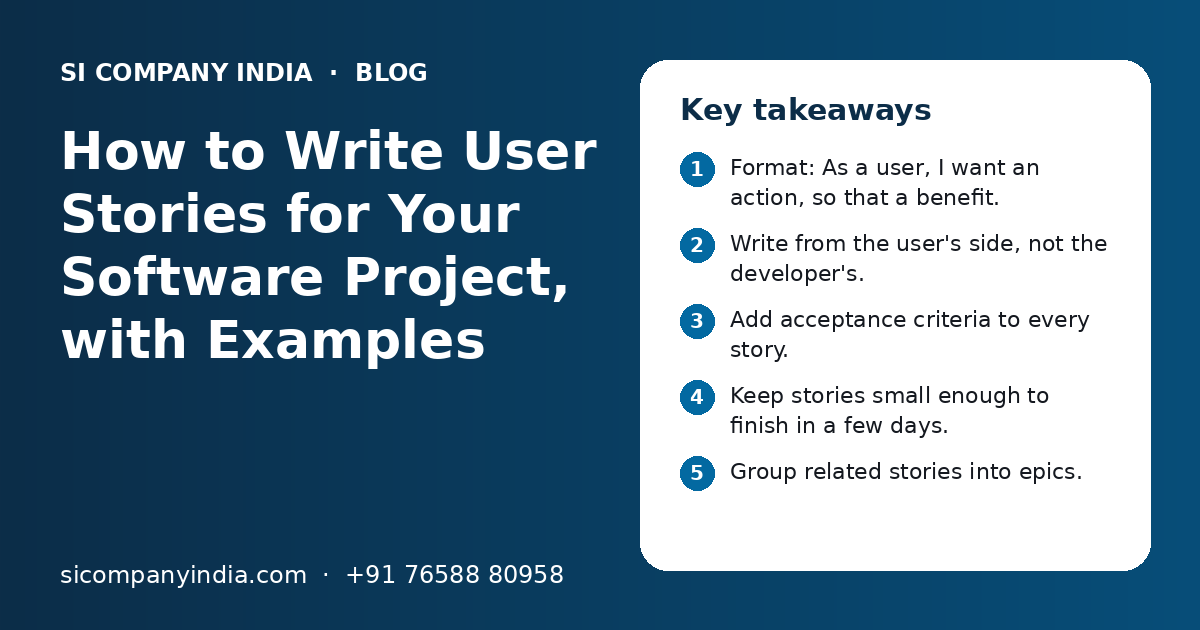
Key takeaways
- Format: As a user, I want an action, so that a benefit.
- Write from the user's side, not the developer's.
- Add acceptance criteria to every story.
- Keep stories small enough to finish in a few days.
- Group related stories into epics.
- Use the criteria to test the finished software.
What is a user story in a software project?
A user story is a short, plain description of one thing a user needs the software to do, and why. It is written from the user's point of view, not in technical words.
User stories come from agile ways of working, where software is built in small parts and shown to the client often. But you do not need to know agile to write them. If you can explain your daily work, you can write a good user story.
Stories are useful because they keep the focus on people and outcomes. A line like "add a filter" says little. A line like "As an accountant, I want to filter invoices by month so that I can file GST returns faster" tells the developer who uses it and why it matters.
What is the simple user story format?
The most common format is: As a [type of user], I want [to do something] so that [I get a benefit]. Each part answers one question: who, what and why.
| Part | Question it answers | Example |
|---|---|---|
| As a ... | Who is the user? | As a delivery boy |
| I want ... | What do they want to do? | I want to mark an order as delivered from my phone |
| so that ... | Why does it matter? | so that the office knows without calling me |
Tips for each part
- Who: use a real role, such as store manager, dealer or accountant. Avoid just "user".
- What: describe an action, not a screen or a button.
- Why: state the business benefit. If you cannot write the why, ask if the feature is needed at all.
Some teams also give each story a short title and an ID, such as US-12 Mark order delivered. This makes it easy to talk about stories in meetings and on WhatsApp.
How do you write acceptance criteria for a user story?
Acceptance criteria are a short list of conditions that must be true for the story to be done. Write 3 to 6 clear, testable points under each story.
Simple checklist style
Story: As a dealer, I want to place an order from my phone so that I do not have to call the sales office.
- Dealer can log in with mobile number and OTP.
- Dealer sees only products and rates meant for them.
- Order cannot be placed if quantity is zero.
- Dealer sees GST and total before confirming.
- Dealer and sales office both get a confirmation on WhatsApp.
Given, When, Then style
Some teams write criteria as small scenarios. This style is very clear for testing.
- Given the dealer is logged in, when they add 10 boxes of an item, then the cart shows the dealer rate and GST.
- Given the dealer has an unpaid amount above their credit limit, when they try to place an order, then the app shows a message and does not accept the order.
Either style works. Pick one and use it for the whole project. The key is that anyone can read a point and say yes or no.
What are some user story examples for Indian SMEs?
Here are sample stories from common Indian business software. Use them as a pattern, then write your own with your real roles and steps.
| Business | User story | One key acceptance point |
|---|---|---|
| Distributor | As a salesperson, I want to see a dealer's pending dues before taking an order so that I do not book orders for dealers over their limit. | Dues shown match the accounts data. |
| Retail shop | As a cashier, I want to accept UPI and see the payment status on the bill screen so that I do not depend on the customer's screenshot. | Bill is marked paid only after payment is confirmed. |
| Clinic | As a receptionist, I want to send the appointment time on WhatsApp so that patients come on time. | Message goes out when the booking is saved. |
| Manufacturer | As a store keeper, I want to issue raw material against a job card so that stock and job cost stay correct. | Stock reduces and the job card shows the issue. |
| Service company | As a technician, I want to upload a photo of the finished work so that the customer and office can see proof. | Photo is saved with date and job number. |
| Any GST business | As an accountant, I want to export the month's sales invoices for Tally so that I do not type them again. | Totals in the export match the sales report. |
Notice that each story has one user, one action and one clear reason. Indian needs such as UPI payment integration, WhatsApp Business API messages and Tally integration fit naturally into stories. Writing them this way early helps developers plan these links from day one.
Need help with your project?
Talk to the SI Company India team. Free first call, simple advice, clear quote.
How small should a user story be?
A user story should be small enough for the team to build and test in a few days. If a story feels big or has many "and" words, split it.
Ways to split a big story
- By step: search product, add to cart, confirm order.
- By user type: dealer view and sales manager view.
- By rule: normal order first, then credit-limit check.
- By channel: web first, mobile app later.
- By data: one branch first, many branches later.
Many teams use the INVEST idea as a quick test. A good story is Independent, Negotiable, Valuable, Estimable, Small and Testable. You do not need to remember the word. Just ask: can we build it alone, does it help someone, and can we test it?
How do user stories link to requirements and testing?
User stories describe what users need. Requirements add the full rules and limits. Testing checks each story against its acceptance criteria. Together they form one chain from idea to working software.
- 1
Start with the business problem
Write the main goal and the list of users. Our software requirements checklist helps you cover the big picture first.
- 2
Break the work into epics
Group by area, such as orders, billing, stock and reports.
- 3
Write user stories under each epic
One need per story, in the As a, I want, so that format.
- 4
Add acceptance criteria
3 to 6 testable points per story.
- 5
Add non-functional needs separately
Speed, security, languages, devices and backups apply to the whole system, so list them once, not in every story.
- 6
Estimate and plan
Developers estimate each story. You choose which stories go into the first release.
- 7
Test against the criteria
When a story is built, check every acceptance point. If all pass, mark it done.
| Document | What it covers | Who mostly uses it |
|---|---|---|
| Requirements checklist | Goals, users, scope, integrations, budget and timeline | Owner and vendor at the start |
| User stories | Each user need in one line, with its reason | Owner, product person and developers |
| Acceptance criteria | Rules that prove a story is done | Developers and testers |
| Test cases | Detailed steps and data to test each criterion | Testers |
So the requirements checklist sets the scope. User stories break that scope into small, useful pieces. Acceptance criteria turn each piece into something you can check.
What mistakes should you avoid when writing user stories?
The most common mistakes are writing stories like technical tasks, leaving out the reason, and skipping acceptance criteria. Each of these leads to rework later.
| Weak story | Problem | Better story |
|---|---|---|
| Add a dropdown for state. | A task, not a user need | As a billing clerk, I want to pick the customer's state so that GST is split correctly. |
| As a user, I want reports. | Vague user and vague need | As the owner, I want a daily sales summary on my phone so that I know the day's business. |
| As an admin, I want to manage orders, stock, users and settings. | Too big | Split into four stories, one for each. |
| As a dealer, I want to place orders. | No acceptance criteria | Add rules for login, rates, GST, limits and confirmation. |
- Do not name screens and buttons in the story. Leave design to the team.
- Do not write all stories alone. Ask the staff who will use the software.
- Do not mix two users in one story.
- Do not use words like fast or easy without saying what they mean.
- Do not treat stories as fixed. Refine them as you learn.
Who should write the user stories?
The business owner or a product person should own the stories, but they should be written with the people who will use the software. Developers then help refine them.
In a small Indian business, this is often the owner, a manager and one person from accounts or operations. Sit with them, walk through a normal day, and write down each step as a story. A short call with a technology consultant can help if you are not sure where to start.
Benefits of writing stories yourself
- You know your business process best
- Quotes from vendors become easier to compare
- Fewer surprises at the testing stage
- You stay in control of priorities
Things to watch
- It takes a few hours of focused time
- You may miss technical needs like security
- Stories can become too big without review
- A developer should still check each story
How do user stories affect project cost and timeline?
Clear user stories make estimates more accurate, because developers can size each small piece. Vague stories lead to wide estimates and changes later, which add time and cost.
Stories also let you plan releases. You can mark each story as must-have or later, build the must-haves first, and add the rest after launch. Read more on what affects software development cost in India and how long custom software takes.
SI Company India, powered by Shivah Web Tech, helps businesses turn ideas into clear stories before any code is written. We then build custom software or a web application from them. You get a clear quote after a free call. Contact us to book one.
Frequently Asked Questions
What is the difference between a user story and a requirement?
A requirement is any need the software must meet, often written as a rule, such as the system must calculate GST. A user story is one way to write a requirement, from the user's side, with the reason included. Most projects use both: a requirements document for scope and overall rules, and user stories for the detailed features.
How many user stories does a small software project need?
There is no fixed number. It depends on how many users, steps and features the software has. A small tool may have a few dozen stories, while a larger system has many more grouped into epics. Focus on covering every important task each user does, rather than reaching a certain count.
Can I write user stories in Hindi or another Indian language?
Yes. The aim is shared understanding, so write in the language your team is most comfortable with. If your developers work in English, you can write the first draft in Hindi or Punjabi and then translate it together. Keep the who, what and why structure the same in any language.
Who writes acceptance criteria, the client or the developer?
Ideally both. The client or business owner writes the first version, because they know what done means for the business. The developer and tester then add details, such as error messages and edge cases. Agree on the final criteria before work starts, so testing at the end is simple and fair.
Do I need special software to write user stories?
No. You can write user stories in a Google Sheet, an Excel file or a shared document. Use columns for ID, epic, story, acceptance criteria, priority and status. Many development teams use project tools, but a simple sheet is enough for a small business to get started and share with vendors.
Is a user story enough to get a quote from a software company?
User stories help a lot, but a good quote also needs the bigger picture: the business goal, users, integrations, devices, timeline and budget range. Share your user stories along with a short requirements list. This lets the vendor understand both the detail and the scope, and gives you quotes that are easier to compare.
What is a good example of a user story with acceptance criteria?
Story: As a shop owner, I want to see today's total sales on my phone so that I know the day's business without calling the shop. Criteria: total includes cash, UPI and card; it updates when a bill is saved; only the owner can see it; it shows yesterday's total for comparison.